
Mid Cap Stocks Forecast: AI Beats the S&P500 by 32.52%
Executive Summary
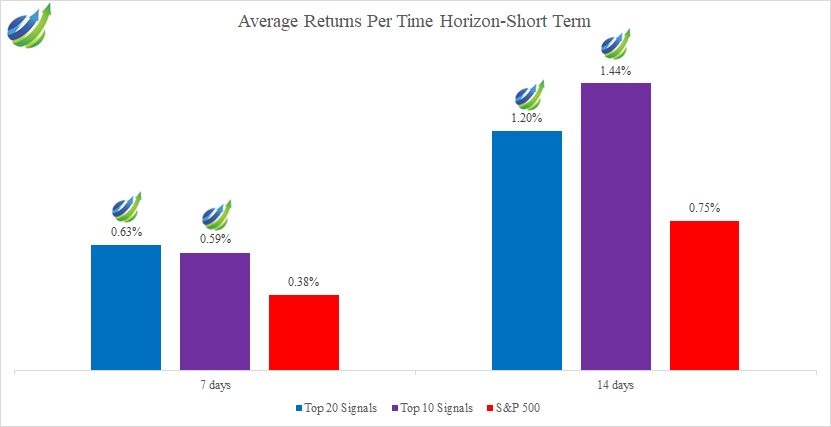
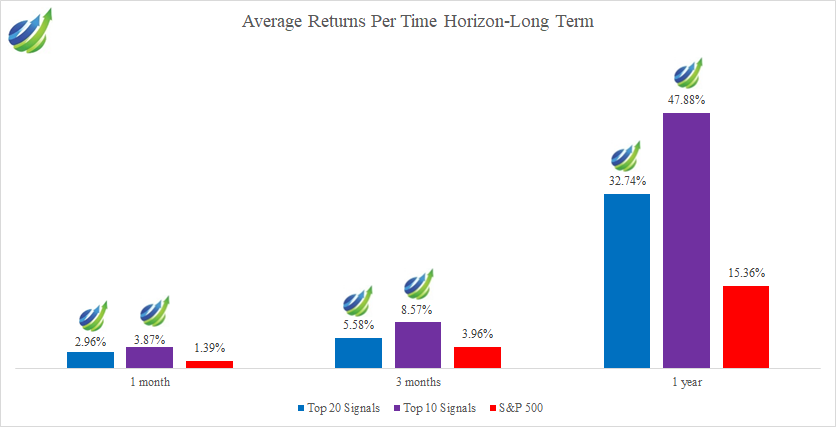
The purpose of this Mid Cap stocks forecast report is to present the results of the live forecast performance evaluation of long positions for the Mid Cap stocks package by the I Know First AI Algorithm. The following results were observed when the signal filter was applied. The evaluation period is from 1st October 2024 to 28th January 2026. The corresponding returns distribution of stock signal filters for this package is shown below:
The Tech Stocks Forecast Report Highlights:
- The highest average return is 47.88% for the Top 10 Signals on a 1-year time horizon.
- The average return across all signal and horizon groups is positive.
- Predictions reach up to a 71% hit ratio regardless of economic conditions.
About the I Know First Algorithm
The I Know First self-learning algorithm analyzes, models, and predicts the stock market. The algorithm is based on Artificial Intelligence (AI) and Machine Learning (ML) and incorporates elements of Artificial Neural Networks and Genetic Algorithms.
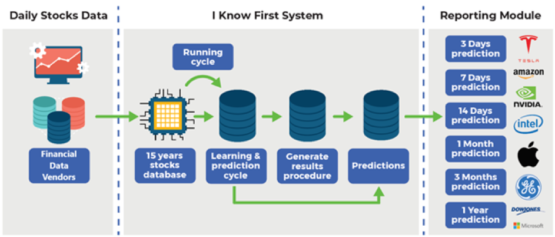
The system outputs the predicted trend as a number, positive or negative, along with a wave chart that predicts how the waves will overlap the trend. This helps the trader to decide which direction to trade, at what point to enter the trade, and when to exit. Since the model is 100% empirical, the results are based only on factual data, thereby avoiding any biases or emotions that may accompany human-derived assumptions.
The human factor is only involved in building the mathematical framework and providing the initial set of inputs and outputs to the system. The algorithm produces a forecast with a signal and a predictability indicator. The signal is the number in the middle of the box. Predictability is the number at the bottom of the box. At the top, a specific asset is identified. This format is consistent across all predictions.
Our algorithm provides two independent indicators for each asset – Signal and Predictability.
The Signal is the predicted strength and direction of the movement of the asset. Measured from -inf to +inf.
Predictability indicates our confidence in that result. It is a Pearson correlation coefficient between past algorithmic performance and actual market movement. Measured from -1 to 1.
You can find a detailed description of our heatmap here.
The Stock Market Forecast Performance Evaluation Method
We perform evaluations on the individual forecast level. It means that we calculate what would be the return of each forecast we have issued for each horizon in the testing period. Then, we take the average of those results by strategy and forecast horizon.
For example, to evaluate the performance of our 1-month forecasts, we calculate the return of each trade by using this formula:

This simulates a client purchasing the asset based on our prediction and selling it exactly 1 month in the future.
We iterate this calculation for all trading days in the analyzed period and average the results.
Note that this evaluation does not take a set portfolio and follow it. This is a different evaluation method at the individual forecast level.
The Hit Ratio Method
The hit ratio helps us to identify the accuracy of our algorithm’s predictions.
Using our Daily Forecast asset filtering, we predict the direction of the movement of different assets. Our predictions are then compared against the actual movements of these assets within the same time horizon.
The hit ratio is then calculated as follows:

For instance, a 90% hit ratio for a predictability filter with a top 10 signal filter would imply that the algorithm correctly predicted the price movements of 9 out of 10 assets within this particular set of assets.
The Benchmarking Method – S&P 500 Index
In order to evaluate our algorithm’s performance in comparison to the US market, we used the S&P 500 index as a benchmark.
The S&P 500 measures the stock performance of the largest 500 companies by market cap listed on different stock exchanges in the United States. It is one of the most followed equity indices and is frequently used as the best indicator for the overall performance of US public companies, and the US market as a whole. The S&P 500 is a capitalization-weighted index, the weight of each company in the index is determined based on its market cap divided by the aggregate market cap of all the S&P 500 companies.
For each time horizon, we compare the S&P 500 performance with the performance of our forecasts.
Tech Stocks Performance Evaluation – Overview
In this report, we conduct testing of long positions for the Mid Cap Stocks Forecast that I Know First covers by its algorithmic forecast. The period for evaluation and testing is from October 1st, 2024 to January 28th, 2026. During this period, we were providing our clients with daily forecasts in time horizons spanning from 7 days to 1 year which we evaluate in this report.

As can be seen in the table above, our algorithm provided positive returns for most of the time horizons. The S&P 500 benchmark is outperformed in most signal groups for most of the time horizons.


From the above charts, it is evident that as the forecasting horizon expands, the average returns tend to become higher. For the 14-day time horizon, the Top 5 Signals group significantly outperformed the benchmark index – by more than 1.92 times resulting in an average return of 1.44% versus the S&P 500’s average return of 0.75%. Ultimately, the I Know First algorithm shows the highest average return for the 1-year forecast as 47.88% for the Top 10 Signals which exceeds the S&P 500 index by 32.52%.

According to the table above, all the signal groups across all time horizons gave a hit ratio greater than 50%. It should be noted that as the time horizon gets longer, I Know First hit ratios increase from the 52% ratio interval for the short-term horizons to 71% at all subsets for the 1-year horizon. Examining Table 2 shows that a hit ratio for the Top 10 Signals is associated with the highest average return of 47.88%.

Looking at Figure 3, it is clear that at the short term horizons the hit ratios are relatively low at all signal indicators but the hit ratios increase over the long term horizons showing the I Know First Algorithm is able to successfully predict most of the stock movements.
Mid Cap Stocks: Conclusion
This report looked at the live performance forecast of I Know First data for the Mid Cap Stocks Package from October 1th, 2024 to January 28th, 2026. From the above data, we can observe that the I Know First Algorithm is exceeding the S&P 500 benchmark index across all signal filtering subsets and forecasting periods in most groups. Data from Figures 1 and 2 above shows I Know First was able to generate a return that exceeded the S&P 500 return by 32.52% in one year. In the 14-day period, the Top 10 Signals return is 1.44% that exceeds the S&P500 index by 0.69%.


