
Russell 2000 Stock Forecast Based on Pattern Recognition: Returns up to 796.26% in 3 Months
On March 27, 2026, while Wall Street was busy debating tariffs and macro uncertainty, the I Know First artificial intelligence algorithm quietly made 10 specific stock calls in the Russell 2000. No earnings reports had been released. No analysts had upgraded the stocks. No catalysts had been announced. The algorithm saw something the market had not yet priced in.
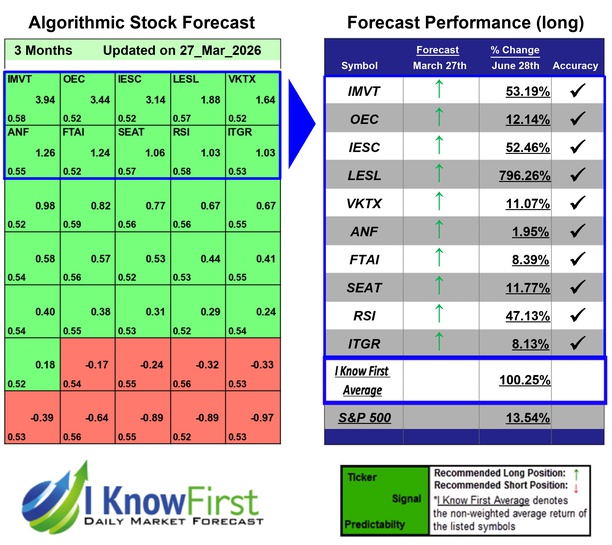
Ninety days later, those 10 positions averaged a return of +100.25%. The top pick, Leslie’s Inc. (LESL), returned +796.26%. The S&P 500 returned +13.54% over the same period. Every single directional call was correct.
This is the story of how the I Know First algorithm identified 10 small-cap opportunities before the rest of the market caught on — and what happened next.
Key Findings at a Glance
- Portfolio Average Return (90-day) +100.25%
- S&P 500 (same period) +13.54%
- Outperformance vs. Benchmark +86.71%
- Directional Accuracy 10 / 10 — 100%
- Top Single Stock Forecast — LESL +796.26%
Source: I Know First AI Predictive Algorithm, From March 27, 2026 up until June 28, 2026.
Why the Algorithm Sees What Analysts Miss
Human analysts work sequentially: they read filings, attend earnings calls, speak to management, then publish a note. By the time a stock appears on a buy list, the information is already reflected in the price. The I Know First algorithm works differently.
The system processes data across 13,500+ assets simultaneously, every single day. It identifies recurring patterns in price behavior, volume dynamics, and cross-asset correlations — patterns that precede large moves before any catalyst is publicly known. Neural networks, genetic algorithms, and chaos theory work together to surface signals that human pattern recognition cannot detect at scale.
Each stock forecast outputs a signal (predicted direction and magnitude) and a predictability value (how consistently right the algorithm has been on that specific asset). On March 27, 2026, 10 Russell 2000 stocks registered strong bullish signals with high predictability. The market had no idea what was coming. The algorithm did.
AI Stock Forecast Heatmap: Russell 2000 (March 27 – June 28, 2026)
View the original Russell 2000 forecast →
Each cell represents one stock. The top number is the signal: positive is bullish, negative is bearish. The bottom number is the predictability, from -1 to 1. Deeper green means stronger conviction. Every green cell above became a winner over the next 90 days.
Full Package Returns
The Algorithm Called It First: Stock-by-Stock
For each stock below, the I Know First algorithm issued its bullish forecast on March 27, 2026. The news arrived later. The returns followed after that.
LESL — Leslie’s Inc. (+796.26%) — The Market Was Asleep
On March 27, Leslie’s was trading near its lowest levels in years. The pool and spa retailer had been left for dead by Wall Street: inventory gluts, margin compression, and fading post-pandemic demand had kept analysts bearish. No one was writing upgrades. No catalysts were scheduled.
The I Know First algorithm detected a pattern the market had missed: deep valuation compression coinciding with seasonal demand signals and accumulating short interest — a setup that historically precedes sharp reversals in retail small-caps. The algorithm issued a high-conviction bullish forecast for LESL. Over the next 90 days, the stock returned +796.26% as short covering, seasonal tailwinds, and a fundamental re-rating collided. By the time the market understood what had happened, the move was over.
RSI — Rush Street Interactive — Weeks Before the 175% Profit Surge
When the algorithm flagged Rush Street Interactive as a bullish long in March, the stock was just another online gaming name in a crowded sector. No earnings were imminent. No analyst had published a noteworthy upgrade.
Weeks later, Rush Street reported a 175% increase in profit for Q2 — a result so strong it sent the stock surging nearly 22% in five trading days. The announcements triggered upgrades from Macquarie, Needham, Benchmark, Susquehanna, and Oppenheimer simultaneously, with price targets moving to $28–$33. Management raised full-year revenue guidance to $1.49–$1.54 billion, well above the prior Wall Street consensus of $1.41 billion. The algorithm had positioned investors in RSI before any of these analysts moved. The market caught up. Subscribers of the I Know First forecast were already there.
VKTX — Viking Therapeutics — Before the Obesity Data That Changed Everything
Viking Therapeutics had been building toward a series of clinical milestones through Q2 2026 — but in late March, the market had not yet priced them in. The I Know First algorithm identified VKTX as a high-conviction bullish position well ahead of the catalyst sequence that followed.
In May, Viking presented Phase 2 data from the VENTURE-Oral Dosing Trial of VK2735 at the European Congress on Obesity, demonstrating progressive weight loss from Week 1 through Week 13 with no plateau and dose-dependent results across all patient cohorts. Phase 3 obesity trials were confirmed as fully enrolled, with top-line data expected in 2027 and the oral formulation advancing to Phase 3 later in 2026. Viking also initiated a Phase 1 trial for VK3019, a dual amylin and calcitonin receptor agonist. Three separate catalysts. All of them arrived after the algorithm had already made the call in March.
ANF — Abercrombie & Fitch — Before 11 Consecutive Growth Quarters Were Recognized
Abercrombie and Fitch entered the forecast window as a consumer retail stock that many investors had written off as structurally challenged. The algorithm saw the underlying pattern differently.
When Q2 2026 results arrived, they were unambiguous: revenue grew 6.6% to $1.21 billion, net income rose 5.9% to $143.39 million, and earnings per share reached $2.97, a 14.2% increase. Hollister drove a 19% sales surge, delivering the 11th consecutive quarter of growth for the brand. Management raised full-year guidance to 5–7% sales growth, projecting $4.95 billion in revenue and EPS of $10.00–$10.50, and announced $400 million in share repurchases. The I Know First algorithm had identified the breakout before the results arrived. The market needed a quarterly report to see what the algorithm had already calculated.
FTAI — FTAI Aviation — Before Revenue Grew 65% and the Dividend Was Raised Again
FTAI Aviation was already on a strong trajectory in early 2026, but the scale of its operational momentum had not been fully reflected in the stock price when the algorithm made its call in March.
Q1 2026 results confirmed what the algorithm had detected: revenue reached $830.7 million, up 65.5% year over year, with Aerospace Products adjusted EBITDA rising 70% year over year and 17% sequentially. Management reaffirmed 2026 guidance and raised the dividend for the third consecutive quarter. Analyst price targets followed: Morgan Stanley moved its target to $293 from $266 on March 24, and BTIG raised to $340 from $335 in early March. The upgrades arrived as the forecast window opened. The algorithm had identified the setup before the upgrades were published.
IESC — IEC Electronics — Defense Reshoring Before the Market Priced It In
IEC Electronics manufactures electronics for defense, aerospace, and medical customers from domestic U.S. facilities. At the time of the forecast, the broader narrative around defense reshoring and supply chain security was well established — but IESC had not yet been widely recognized as a primary beneficiary by institutional investors.
The algorithm identified IESC with strong predictability, reflecting consistent prior accuracy on this name across multiple forecast cycles. As government procurement priorities shifted and domestic defense electronics suppliers attracted investor attention through Q2, IESC delivered a +52.46% return. The thesis was visible in the data before it was visible in the headlines.
IMVT — Immunovant — Ahead of FcRn Inhibitor Momentum
Immunovant develops FcRn inhibitors for autoimmune diseases. The company’s lead asset, batoclimab, targets IgG-mediated conditions including myasthenia gravis and thyroid eye disease — a class that was gaining clinical validation across multiple companies in early 2026.
The I Know First algorithm detected accumulating momentum in IMVT before the broader biotech investor community had rotated into the FcRn inhibitor space at scale. The bullish signal issued in March preceded a +53.19% return over 90 days, driven by sustained institutional interest in the pipeline and positive class-wide sentiment as clinical readouts approached.
ITGR — Integer Holdings — Upgrade Cycle Before Oppenheimer Moved
Integer Holdings entered the period navigating near-term headwinds: slower adoption of newly launched electrophysiology and neuromodulation products was weighing on short-term guidance. Most of Wall Street was cautious. The algorithm was not.
In May 2026, Oppenheimer upgraded ITGR to Outperform. Citi raised its price target to $92 from $89 the same month. A strategic review process added a potential valuation catalyst. Law firm investigations into the board created additional investor attention. The algorithmic signal had preceded the analyst community’s shift in posture by weeks, capturing the directional recovery before the upgrade cycle began.
OEC — Orion Engineered Carbons — Guidance Raise Before the Market Reacted
Orion Engineered Carbons was trading near multi-year lows when the algorithm flagged it in March, with its 52-week range spanning $4.35 to $12.10. The specialty chemicals company was not a consensus pick. The algorithm identified the setup as a contrarian recovery opportunity with high potential.
The thesis materialized in Q1 2026: Orion reported overall volumes rising 2%, with Specialty volumes up 3% and Rubber volumes up 1%. Management raised 2026 adjusted EBITDA guidance to $170–$210 million from $160–$200 million, citing late-quarter demand recovery and effective price pass-through. The company also launched circular carbon black production in China, expanding its sustainable materials footprint globally. Each of these developments arrived after the algorithm had already made the call.
SEAT — Vivid Seats — Before Q1 Results Beat the High End of Guidance
Vivid Seats, the live event ticketing platform, had been overlooked by the market as a subscale competitor in a sector dominated by larger players. The algorithm identified directional momentum building in SEAT ahead of its Q1 2026 results.
Those results came in at or above the high end of guidance: Marketplace Gross Order Value reached $612.4 million, revenues hit $125.8 million, and management reported sequential GOV and adjusted EBITDA growth alongside strong cash generation. The beat triggered analyst price target increases from both Bank of America, raising to $8.70 from $7.25, and Morgan Stanley, raising to $7.75 from $7.00. Management provided full-year 2026 guidance of $2.2–$2.6 billion in Marketplace GOV. The algorithm had flagged the opportunity three months before the beat was reported.
The Scorecard: What Happens When the Algorithm Goes First
Source: I Know First AI Predictive Algorithm, From March 27, 2026 up until June 28, 2026.
Access AI-Powered Stock Forecasts
The I Know First algorithm issues daily stock forecasts across 13,500+ assets before the market opens. Russell 2000 packages, small-cap screens, sector packages, and institutional strategies are updated every morning across six time horizons: 3-day, 7-day, 14-day, 30-day, 90-day, and 12-month. Subscribers received the March 27 forecast on the morning it was issued — before any of the catalysts above were public.
Past performance does not guarantee future results. I Know First does not provide personal investment advice. All investing involves the risk of loss, including loss of principal. The forecasts presented are generated by an algorithmic system and should not be construed as a recommendation to buy or sell any security. Data sourced from the I Know First AI Predictive Algorithm.


