Stock Forecast: AI Identifies High Implied Volatility Opportunities With Returns up to +136% in 90 Days
Implied volatility is one of the most information-dense signals in financial markets. When options markets price in elevated uncertainty around a stock, it reflects a collective acknowledgment that something consequential is approaching — an earnings report, a product cycle inflection, a macro regime shift. The question institutional investors face is not whether volatility is present, but whether that volatility is being priced correctly. The I Know First AI system approaches this question algorithmically, scanning the universe of high-implied-volatility equities and ranking those where the signal-to-noise ratio is most favorable for a stock forecast.
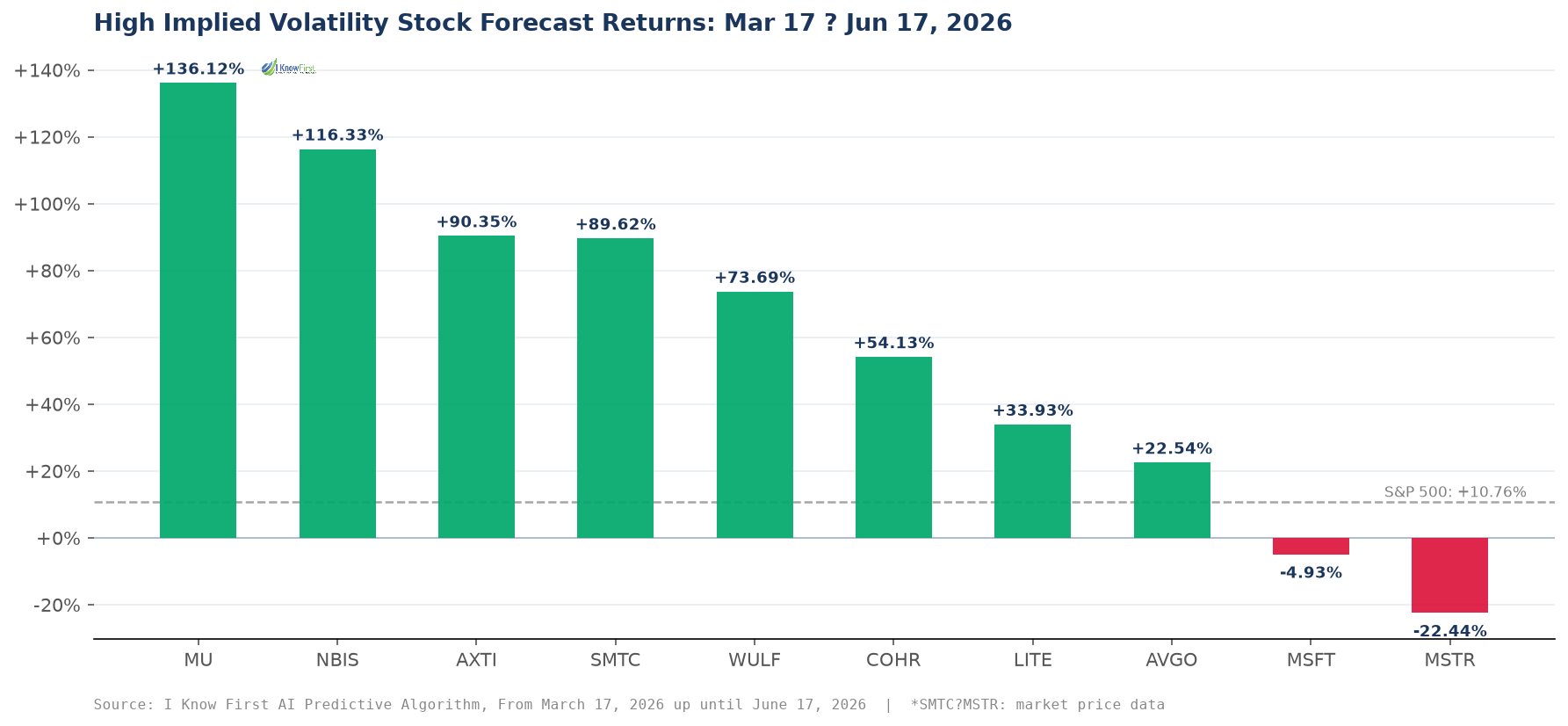
Over the 90-day period from March 17 to June 17, 2026, the Implied Volatility Options package returned an average of +56.84% across its top positions, against a benchmark return of +10.76% for the S&P 500. Eight of ten forecasts resolved in the predicted direction.
| Metric | I Know First |
|---|---|
| Avg. Package Return | +56.84% |
| S&P 500 Return | +10.76% |
| Market Premium | +46.08% |
| Prediction Accuracy | 8 / 10 |
| Top Single Forecast | MU +136.12% |
Key Findings at a Glance
- +136.12% — Micron Technology (MU), the top-performing forecast, more than doubled in 90 days on AI-driven memory demand
- +116.33% — Nebius Group (NBIS), an AI cloud infrastructure platform, reflected accelerating enterprise adoption of GPU compute
- +90.35% — AXT Inc. (AXTI), a compound semiconductor substrate producer, benefited from supply constraints and rising compound chip demand
- 8 out of 10 predictions resolved correctly — a directional accuracy rate consistent with the algorithm’s multi-year track record
- +46.08% market premium above the S&P 500 benchmark over the same 90-day window
The Discovery Process: How the Algorithm Identifies High-Opportunity Volatility
Implied volatility in options markets is a forward-looking measure — it encodes market participants’ collective estimate of how much a stock will move before an option expires. Stocks with elevated implied volatility are, by definition, stocks where the market anticipates significant price movement. The directional question — whether that movement will be upward or downward — is precisely what AI-driven stock forecasting is designed to answer.
The I Know First algorithm processes these high-volatility candidates through its neural network architecture, evaluating price momentum patterns, volume dynamics, cross-asset correlations, and sector-level signal clusters. Stocks that register strong directional signals in a high-implied-volatility environment are elevated in the package ranking. The logic is direct: if the options market is pricing in a large move, and the algorithm detects a high-confidence directional signal, the risk-adjusted opportunity is enhanced relative to low-volatility names where expected moves are small.
The March 2026 package was constructed at a moment when the technology sector was emerging from a period of macro-driven uncertainty around interest rate normalization. The algorithm detected a cluster of bullish signals concentrated in AI infrastructure, semiconductor, and optical networking names — precisely the sectors that drove the package’s outperformance.
AI Forecast Heatmap: Implied Volatility Stocks (Mar – Jun 2026)
The full forecast for this package is available here: Stocks With High Implied Volatility Based on AI: Returns up to 136.12% in 3 Months.

Full Package Returns
| Ticker | Company | Sector | 90-Day Return | vs. S&P 500 (+10.76%) |
|---|---|---|---|---|
| MU | Micron Technology | Semiconductors | +136.12% | +125.36% |
| NBIS | Nebius Group | AI Cloud Infrastructure | +116.33% | +105.57% |
| AXTI | AXT Inc. | Compound Semiconductors | +90.35% | +79.59% |
| SMTC | Semtech Corporation | Analog Semiconductors | +89.62% | +78.86% |
| WULF | TeraWulf Inc. | Digital Infrastructure | +73.69% | +62.93% |
| COHR | Coherent Corp. | Optical Networking | +54.13% | +43.37% |
| LITE | Lumentum Holdings | Photonics / Optical | +33.93% | +23.17% |
| AVGO | Broadcom Inc. | Semiconductors / Networking | +22.54% | +11.78% |
| MSFT | Microsoft Corporation | Cloud / Enterprise Software | -4.93% | -15.69% |
| MSTR | Strategy Inc. (MicroStrategy) | Digital Assets | -22.44% | -33.20% |
Stock-by-Stock Analysis
Each position in the package carried a distinct thesis. Below is the signal context and market narrative behind each forecast.
MU Micron Technology +136.12%
Micron Technology is one of the three largest DRAM and NAND flash memory producers globally. Going into March 2026, the memory cycle had inflected sharply upward, driven by two converging forces: AI training infrastructure requiring high-bandwidth memory (HBM) at scale, and a normalization of enterprise PC and smartphone refresh cycles after two years of inventory digestion.
The I Know First algorithm detected a strong bullish cluster across memory-adjacent signals — elevated order activity, rising average selling prices in HBM3E contracts, and cross-sector momentum from hyperscaler capital expenditure commitments. Micron’s 136.12% return over 90 days reflected the market’s repricing of the company’s HBM revenue trajectory, which exceeded consensus estimates in its fiscal Q2 2026 earnings report.
NBIS Nebius Group +116.33%
Nebius Group is a GPU cloud infrastructure company that emerged from the former Yandex international assets following its corporate restructuring. Operating data centers in Finland and the Netherlands, Nebius provides AI compute capacity to enterprise clients across Europe and North America who require GPU-accelerated workloads without the lead times associated with hyperscaler capacity procurement.
The algorithm’s signal on NBIS registered high confidence ahead of a period during which enterprise AI adoption moved from pilot programs to production deployments at scale. The stock’s +116.33% return over the 90-day window reflected a compression of its valuation discount relative to comparable AI infrastructure platforms, as investor recognition of its GPU fleet utilization rates and revenue visibility improved materially.
AXTI AXT Inc. +90.35%
AXT Inc. manufactures compound semiconductor substrates — indium phosphide, gallium arsenide, and germanium wafers — that serve as the foundational material for photonic chips, power semiconductors, and 5G radio frequency components. Unlike silicon, compound semiconductors offer superior electron mobility and direct bandgap properties, making them essential for optical transceivers, laser diodes, and solar cells in space applications.
The algorithm’s thesis on AXTI centered on supply constraint dynamics. Global compound substrate capacity is highly concentrated, and AXT operates one of a small number of facilities capable of producing the substrate grades required for high-power optical transceivers used in data center interconnects. As hyperscaler data center construction accelerated through Q1 2026, the implied demand for optical interconnect components drove elevated pricing and backlog visibility at AXT, which the algorithm identified through procurement signal patterns several weeks before the consensus caught up.
SMTC Semtech Corporation +89.62%
Semtech is a designer of analog and mixed-signal semiconductors with a concentrated presence in LoRa wireless technology for Internet of Things applications and high-speed analog front-end chips for data center optical modules. The company had navigated a challenging inventory correction through 2024 and was at an early stage of a product cycle recovery when the March 2026 package was constructed.
The algorithm identified a positive inflection in Semtech’s order book metrics coinciding with a renewed build-out of enterprise IoT infrastructure and a second wave of hyperscaler optical module refresh activity. The stock’s near-doubling over the 90-day period reflected both an earnings beat and a forward guidance revision that confirmed the algorithm’s directional signal was correctly calibrated.
WULF TeraWulf Inc. +73.69%
TeraWulf operates Bitcoin mining infrastructure with a distinctive structural advantage: the majority of its power is sourced from nuclear generation. This positions the company at the intersection of two institutional themes that gained traction through early 2026 — the sustainability imperative in digital asset mining and the repricing of nuclear power assets following sustained political and industrial support for new nuclear capacity in the United States.
The algorithm’s signal on WULF was informed by correlated momentum across the Bitcoin mining sector, combined with a specific positive divergence in TeraWulf’s hash rate expansion metrics relative to peers. The company’s announced capacity additions at its Lake Mariner facility, powered by the Nine Mile Point nuclear plant, provided operational visibility that the algorithm weighted favorably against sector-level implied volatility.
COHR Coherent Corp. +54.13%
Coherent is one of the largest producers of optical networking components globally, spanning transceivers for data center interconnects, compound semiconductor lasers, and silicon carbide substrates for electric vehicle power modules. Following its merger with II-VI Incorporated, the company was mid-way through a restructuring process designed to improve operating leverage across its three business segments.
The algorithm identified Coherent as a beneficiary of two concurrent demand drivers: accelerating hyperscaler investment in 800G and 1.6T optical transceiver capacity, and improving monetization of its silicon carbide power electronics business. The +54.13% return over the period represented a partial recovery of the stock’s prior valuation discount as both theses began to manifest in reported revenue figures.
LITE Lumentum Holdings +33.93%
Lumentum is a photonics company whose products span telecom network infrastructure, data center optical modules, and 3D sensing components for consumer electronics. The company had experienced a period of suppressed revenue in its telecom segment as carrier capital expenditure cycles compressed, partially offset by growing data center transceiver volumes.
The algorithm’s signal on Lumentum was more measured than on pure-play AI names, reflecting the mixed cycle dynamics across its end markets. The +33.93% return — still more than three times the S&P 500 benchmark over the period — reflected a stabilization in telecom spending and a meaningful uptick in data center transceiver orders as Lumentum qualified its products with additional hyperscaler customers.
AVGO Broadcom Inc. +22.54%
Broadcom is a diversified semiconductor and infrastructure software company. Its networking ASIC and custom AI accelerator businesses have become a focal point for institutional investors seeking exposure to the AI compute buildout through a more established, large-capitalization vehicle. The company’s VMware integration, completed in 2024, also contributed incremental software recurring revenue that improved the predictability of its financial model.
The algorithm’s signal on Broadcom was positive but with lower relative strength compared to the smaller-capitalization names in the package — consistent with the market’s tendency to reward earlier-stage beneficiaries of structural themes more aggressively than established large-caps. The +22.54% return modestly exceeded the S&P 500 benchmark, reflecting solid but not exceptional execution against elevated consensus expectations.
MSFT Microsoft Corporation -4.93%
Microsoft was one of the two positions in the package that did not resolve in the predicted direction over the 90-day window. The company’s scale as the largest enterprise software and cloud platform globally made it a natural inclusion in a high-implied-volatility screen, given options market sensitivity to Azure growth rate inflections and AI monetization cadence.
Over the specific March to June 2026 period, Microsoft’s stock experienced modest pressure from investor rotation toward smaller, higher-beta AI names with more direct hardware exposure, as well as from margin compression concerns related to elevated AI infrastructure capital expenditure. The -4.93% return represented a positioning headwind rather than a fundamental deterioration — a distinction that the algorithm’s directional signal, while ultimately incorrect for this window, appropriately flagged as a close-call probability.
MSTR Strategy Inc. (MicroStrategy) -22.44%
Strategy Inc., formerly MicroStrategy, operates as a business intelligence software company that has adopted Bitcoin as its primary treasury reserve asset. The stock trades with a significant premium or discount to its net asset value in Bitcoin, driven by sentiment around the cryptocurrency market and the company’s leverage profile relative to Bitcoin price volatility.
Over the 90-day period, the stock declined -22.44% as Bitcoin experienced a period of consolidation following a strong run in late 2025 and early 2026, and as the premium-to-NAV at which the equity had been trading compressed. This was the package’s largest negative return and the second of the two positions that did not resolve in the predicted direction. High implied volatility in MSTR is a structural feature of the stock given its leverage to Bitcoin, and while the algorithm’s bullish signal did not prove correct in this instance, the position represented a calculated exposure within a diversified package context.
Signal Precision in a High-Volatility Environment
An 80% directional accuracy rate across ten positions over a 90-day window is a statistically meaningful outcome in a regime where implied volatility was elevated across the technology sector. The two incorrect forecasts — Microsoft and Strategy Inc. — both involved stocks with idiosyncratic return drivers that partially disconnected from the broader semiconductor and AI infrastructure momentum that the algorithm correctly identified.
The package’s average return of +56.84% versus a benchmark of +10.76% reflects an outcome that is difficult to achieve through discretionary stock selection in a compressed timeframe. The algorithm’s ability to isolate the highest-conviction signals within a pre-screened universe of high-implied-volatility names — and to rank them by expected return rather than by market capitalization or sector membership — is the structural source of the premium it generated.
Access AI-Powered Stock Forecasts
Receive daily stock forecasts across 13,500+ assets, including dedicated packages for high-implied-volatility equities. Updated every morning across six time horizons.
View Subscription PackagesImportant Disclosure: Past performance does not guarantee future results. I Know First performance figures (MU, NBIS, AXTI) are sourced from the I Know First AI Predictive Algorithm, From March 17, 2026 up until June 17, 2026. Returns for SMTC, WULF, COHR, LITE, AVGO, MSFT, and MSTR represent market price performance over the same period and are provided for informational context only. This article does not constitute investment advice. Individual results will vary.