
February 2026: I Know First’s AI Strategy Outperforms Citadel, Point72, and the S&P 500
Reattach Written By Samy Nakach – Investment Analyst At I Know First
In a month where artificial intelligence fears rattled the market and macro uncertainty weighed on equities, our AI driven Combined Long/Short Strategy delivered +1.93%, beating every major hedge fund and the S&P 500.
February 2026 was precisely the kind of month that separates disciplined, data driven strategies from the crowd. The S&P 500 fell 0.8%, the Nasdaq 100 dropped 2.3%, and even the world’s largest multi strategy hedge funds, managing tens of billions of dollars, struggled to generate meaningful returns. Against this backdrop, I Know First’s AI powered Combined Long/Short Strategy delivered +1.93% for the month, placing it ahead of Citadel’s flagship Wellington fund, Point72, ExodusPoint, Millennium, and the broader market.
This was not a fluke. It was the result of what our algorithm does best: process massive volumes of data, identify directional opportunities across multiple time horizons, and dynamically adjust exposure, all without the emotional biases that weigh on human decision making during volatile markets.
A Turbulent February: What Happened in the Markets
February 2026 delivered a concentrated dose of uncertainty. The month began with a rotation out of mega cap technology stocks, as investors questioned lofty AI related valuations and the sustainability of capital expenditure growth in the sector. The “Magnificent Seven” stocks, which carried the market through much of 2025, reversed course. Technology and Communication Services were the worst performing S&P 500 sectors for the month.
Macro conditions added further pressure. The Supreme Court struck down several administrative tariffs, only for the administration to announce replacement levies, leaving trade policy in limbo. Manufacturing PMI hit a ten month low, and GDP growth for Q4 2025 came in at just 1.4%, well below the prior quarter’s 4.4%. Throughout the month, markets also priced in growing expectations of a potential military confrontation with Iran, adding a layer of geopolitical uncertainty that weighed on investor sentiment.
Then on February 27, hotter than expected PCE inflation data delivered the final blow. The S&P 500 and Dow posted their steepest single day declines in months, dragging the index to a -0.8% monthly close. Rate cut expectations shifted from “imminent easing” to “slower and later,” punishing the most richly valued segments of the market.
AI valuation fears, sticky inflation, trade policy uncertainty, and rising geopolitical expectations all converged into a single month. This was exactly the environment where systematic, data driven investing should prove its worth.
February Performance: IKF vs. Hedge Funds vs. S&P 500
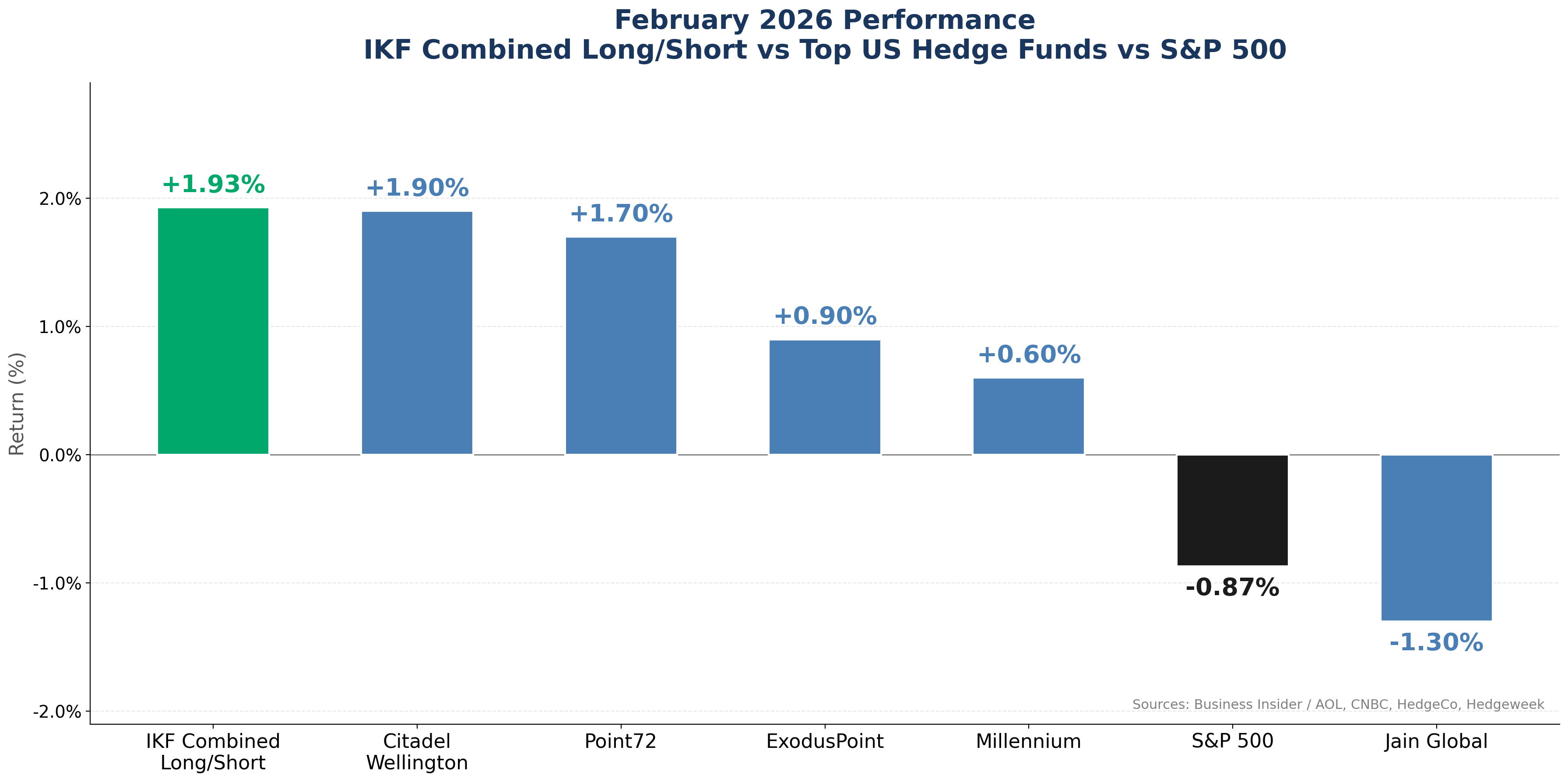
February 2026 monthly returns. Source: Business Insider, CNBC, HedgeCo, Hedgeweek. IKF data from internal Historical Returns.
| Fund | February 2026 |
|---|---|
| I Know First Combined L/S | +1.93% |
| Citadel Wellington | +1.90% |
| Point72 | +1.70% |
| ExodusPoint | +0.90% |
| Millennium | +0.60% |
| S&P 500 | -0.87% |
| Jain Global | -1.30% |
Key takeaway: I Know First’s AI strategy generated +2.80% of alpha over the S&P 500 in February, outperforming Citadel’s $65 billion flagship fund by 3 basis points and delivering more than triple the return of Millennium, the $83.5 billion industry giant.
These hedge funds operate hundreds of trading “pods” across equities, fixed income, commodities, and quantitative strategies. They employ thousands of professionals and manage tens of billions in assets. The fact that an AI driven algorithmic system, operating with a transparent, rules based framework, matched or exceeded their results speaks to the structural advantage of machine intelligence in modern markets.
2026 Year to Date: Widening the Gap

2026 YTD cumulative return, daily data from Historical Returns.
Zooming out to the first two months of 2026, the outperformance becomes even more pronounced. From December 31, 2025 through February 27, 2026, the IKF Combined Long/Short Strategy returned +5.54% while the S&P 500 managed just +0.49%. That represents over five percentage points of alpha in under two months, a pace that, if sustained, would rank among the strongest annual hedge fund performances in the industry.
Since 2020: The Long Term Edge of AI

Cumulative total return since January 29, 2020. Daily price data.
Short term outperformance can be circumstantial. But the real test of any investment strategy is sustained performance through multiple market regimes, and that is where our AI system truly distinguishes itself.
Since inception in January 2020, the I Know First Combined Long/Short Strategy has delivered a cumulative return of +668%, compared to +110% for the S&P 500 over the same period. That is more than six times the market return, generating over 558 percentage points of alpha across six years.
This track record spans the COVID crash of March 2020, the post pandemic recovery rally, the 2022 bear market driven by aggressive Fed tightening, the AI fueled tech rally of 2023 and 2024, the tariff driven volatility of 2025, and now the macro crosscurrents of 2026. Through each regime, the algorithm adapted by adjusting directional exposure, rotating between long and short positioning at each rebalance, and leveraging multi horizon confirmation signals to filter noise from opportunity.
Why AI Beats the Market: The Structural Advantage
The performance data above is not merely historical. It reflects a fundamental structural advantage that AI based forecasting holds over traditional approaches.
Massive data processing at scale. Our algorithm simultaneously analyzes thousands of assets across multiple time horizons, identifying relationships and patterns that no team of human analysts could replicate. Where a portfolio manager might track dozens of variables, our system processes millions of data points daily, including price dynamics, inter market correlations, momentum signals, and mean reversion patterns.
Emotionless risk management. February 2026 was a month of fear: fear of AI disruption, fear of escalating geopolitical tensions, fear of sticky inflation. Human managers, no matter how experienced, are susceptible to cognitive biases during periods of acute uncertainty. Our algorithm does not panic. It processes new information, recalibrates its forecasts, and adjusts exposure based on quantitative signals, not headlines.
Multi horizon confirmation for higher conviction. Our system generates forecasts across multiple timeframes. When the short term, medium term, and long term signals align, we treat that as a higher conviction opportunity. This multi horizon confirmation framework acts as a natural noise filter, reducing the probability of acting on false signals. That is precisely the kind of discipline that protected the portfolio through February’s whipsaw price action.
Directional conviction through systematic rebalancing. Every 28 days, the strategy rebalances and the algorithm determines whether to take a fully long or fully short position based on its forecast signals. This is not a hedged portfolio holding longs and shorts simultaneously. Instead, the model commits to a single directional view each cycle, long when conviction is bullish and short when conviction is bearish. This clear, decisive approach allows the strategy to capture upside in rising markets and profit from declining markets when the signals call for it. In February, this systematic framework positioned the portfolio correctly while the S&P 500 declined.
The bottom line: In a market environment defined by sector rotation, sticky inflation, and rising uncertainty, I Know First’s AI delivered +1.93% for the month, outperforming the S&P 500, Citadel, Point72, Millennium, ExodusPoint, and Jain Global. Since 2020, cumulative returns of +668% versus +110% for the S&P 500 demonstrate that this edge is not episodic. It is structural.
Artificial intelligence is no longer a theoretical concept in portfolio management. It is a proven, institutional grade tool for generating alpha and managing risk, and February 2026 is its latest case study.
Disclaimer: Past performance is not necessarily indicative of future results. All investment strategies involve risk, including possible loss of principal. The returns presented are based on the I Know First Combined Long/Short Strategy as tracked in internal records and are not audited. Hedge fund returns are sourced from publicly available media reports (Business Insider, CNBC, HedgeCo, Hedgeweek) and may reflect different reporting periods or methodologies. S&P 500 returns are based on closing prices from Yahoo Finance. This content is for informational purposes only and does not constitute investment advice or an offer to buy or sell securities.


